
Which Integrations Does Your Startup Actually Need at Launch?
A practical guide to which third-party integrations a new web app genuinely needs on day one, and which ones can wait.
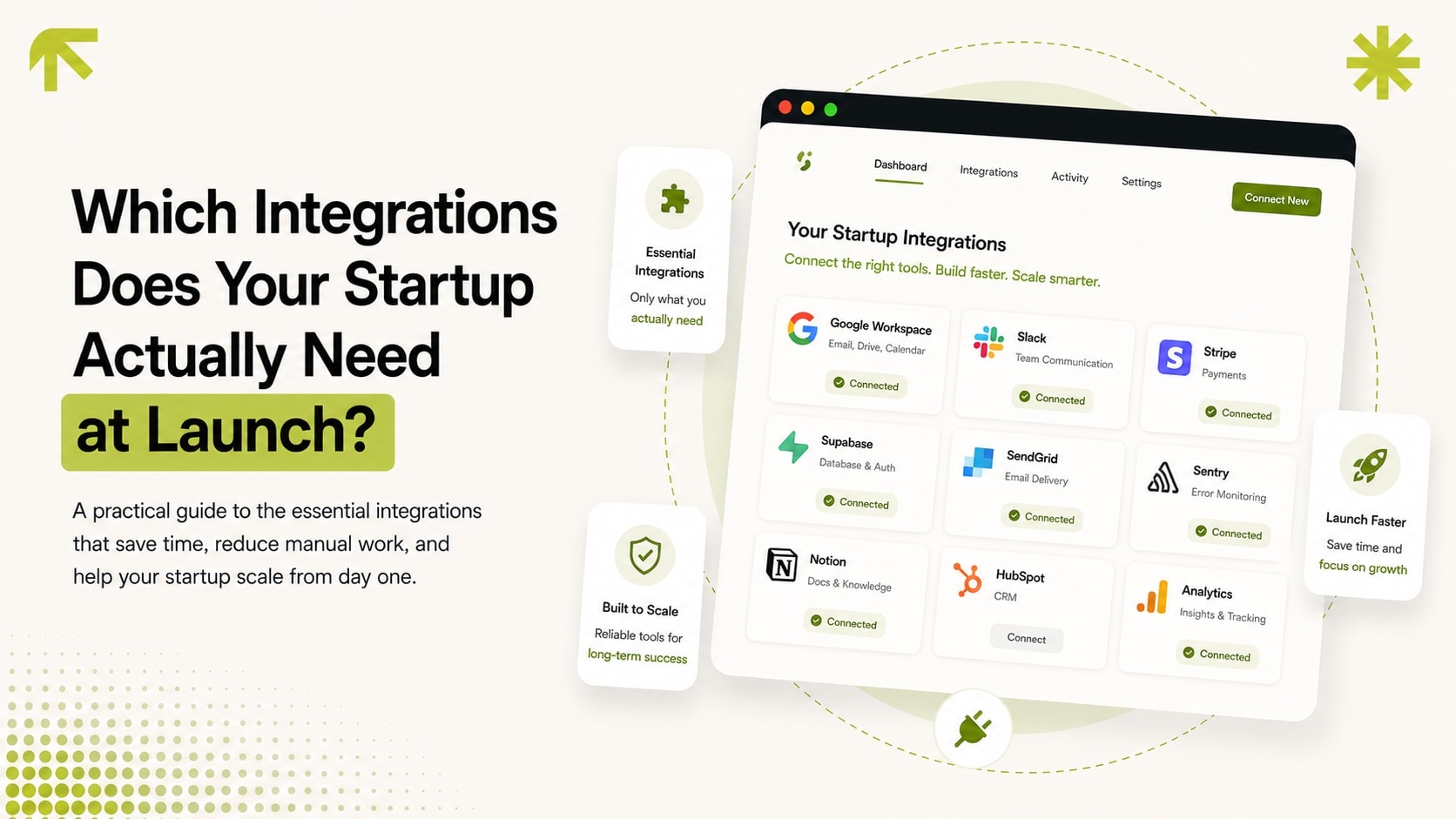
Every new web app ends up needing the same handful of integrations, and every founder ends up wondering which ones actually matter at launch versus which ones are just interesting to think about. Here's the honest breakdown, by category.
Payments: build in at launch if you're charging anyone
If money changes hands on day one, payments aren't optional scope, they're core scope. A provider like Stripe is the default for a reason: proper PCI compliance is handled for you, and the integration effort is small relative to what it would cost to build and secure a payments flow yourself. This is not a "build your own" category, ever, at any stage. It's the same approach we used for the ordering and checkout flow on Grill Bucket's platform.
Authentication: launch with a managed provider, not a custom login system
Rolling your own auth means owning password hashing, session security, and reset-token flows correctly, forever. A managed provider handles this properly out of the box and integrates with a custom app in a day or two, not a month. This is one of the clearest "buy, don't build" categories. The risk of getting auth subtly wrong is high, and the cost of using a managed provider is low. See our fuller take on this in build vs buy for custom software.
Email: transactional from day one, marketing later
Transactional email (signup confirmations, password resets, receipts) needs to work at launch. Users notice immediately when this breaks. Marketing email (newsletters, drip sequences) genuinely can wait until you have a list worth emailing. Don't let "we need an email strategy" block launch; you need transactional email working, and that's a small, well-solved integration.
Analytics: minimal at launch, expand once you have real usage
At launch, you need enough analytics to answer "are people actually using this and where do they drop off," not a full data warehouse. A lightweight event-tracking setup covers this. Building out cohort analysis, attribution modeling, or a BI dashboard before you have meaningful traffic is solving a problem you don't have yet.
What we actually build vs integrate
On every web app project, the pattern is the same: integrate the solved problems (payments, auth, transactional email, baseline analytics), and spend the actual custom-development effort on the parts of the product that are genuinely specific to your business. That split is usually the difference between a launch that takes a few weeks and one that takes months for no good reason.
If you're mapping this out for your own MVP, this pairs well with the scoping questions we ask before any project starts. Integrations are part of the same scoping conversation, not a separate decision made later.
Frequently Asked Questions
Should I build my own authentication to save on subscription costs?
Do I need a full analytics suite before launch?
What if my payment needs are unusual (marketplaces, subscriptions, multi-party payouts)?
What if Stripe isn't well-supported in our region?
Should analytics be privacy-compliant (GDPR etc.) from day one?
Ready to Build Something
That Gets You Clients?
Free 30-minute consultation. We'll map out your project and agree on a price together. No commitment, no pressure.
Book My Free Call