
Custom Software vs Off-the-Shelf Tools: When Building Actually Beats Buying
A practical framework for deciding when to build custom software instead of buying an off-the-shelf tool, with real cost and timeline tradeoffs.
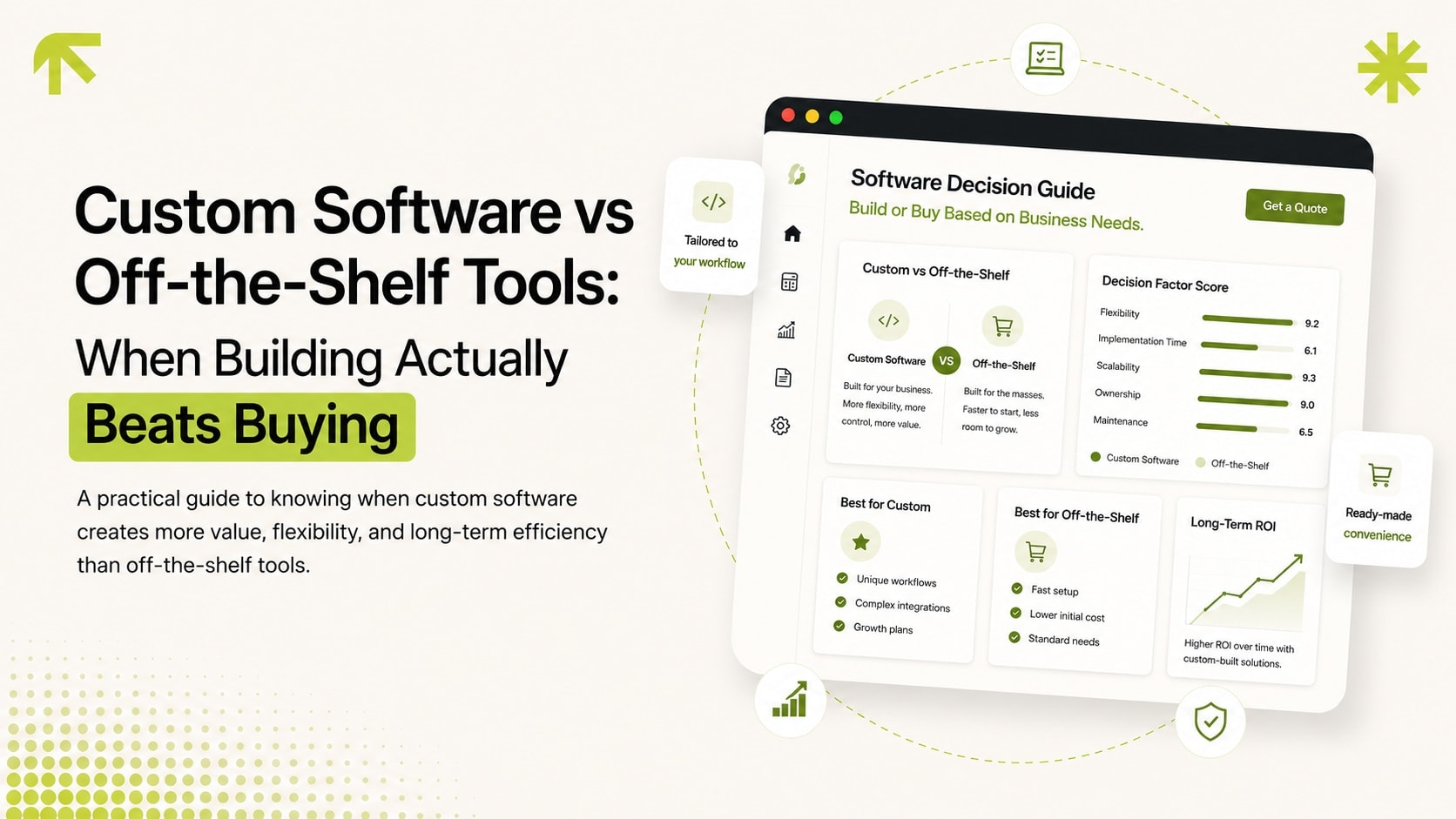
"Just use [SaaS tool]" is the default answer to almost every operational problem, and most of the time it is the right one. A payments provider for payments, a CRM for sales, a docs tool for notes, none of that needs a custom build. But there is a specific point where the off-the-shelf tool stops fitting the business and starts bending the business to fit it, and that is the point worth recognising before you have spent a year working around software that was never built for your workflow.
The real question isn't cost, it's fit
The instinct is to compare a $49/month subscription to a multi-thousand-dollar custom build and conclude the subscription wins. That comparison only works if the subscription actually does what you need. The real question is narrower: is this workflow incidental to your business, or is it the business? A bakery's appointment scheduler is incidental. Any generic booking tool works fine. A property agency's lead-to-viewing pipeline, with its own stages, its own data shape, its own team roles, is not incidental. It is close to the actual product.
Where off-the-shelf genuinely wins
Anything horizontal and well-solved: payments, email delivery, authentication, analytics. Building your own version of a payments processor or an auth provider is almost never the right call. See our breakdown of which integrations are worth buying vs building.
Early-stage validation, before you know your actual workflow well enough to build it correctly.
Anything where per-seat SaaS pricing is still cheaper than the fully-loaded cost of maintaining a custom system long-term.
Where custom starts winning
Your workflow doesn't map to the tool's model. You're renaming fields, building spreadsheets on the side, or running two systems in parallel because neither one alone covers the process.
Per-seat or per-record pricing scales against you. Generic CRMs and dashboards often charge by user or by record: fine at 10 users, painful at 100.
Your data is the asset. If the value of the business increasingly lives in structured data (property listings, leads, inventory), owning that schema outright matters more over time than it seems at month one.
When we built Nova Real Estate's leads and CMS system, a generic CRM would have forced their property categories, listing statuses, and enquiry routing into someone else's data model. Building the admin dashboard around their actual six property categories took the same effort as configuring a bloated generic tool, minus the monthly per-seat bill and the workarounds.
The middle ground most teams miss
"Custom" doesn't mean building everything from zero. The pragmatic version is a custom application layer sitting on top of proven infrastructure, a payments processor, a managed database, a mature auth provider, with only the parts that are actually specific to your business built by hand. That's the model behind most of what we build: custom where it matters, off-the-shelf underneath it where it doesn't.
On cost: we don't run fixed rate cards for this exact reason. A build-vs-buy decision changes the actual scope of work. We talk through what you're trying to replace, agree on a price together, and put it in writing before anything starts (here's the full breakdown of how that works).
Frequently Asked Questions
How do I know if my workflow is "specific enough" to justify custom software?
Is custom software more expensive than SaaS long-term?
Can you build on top of tools we already use instead of replacing everything?
What's a realistic timeline to replace a SaaS tool with custom software?
Can you help migrate our existing data out of the SaaS tool we're replacing?
Ready to Build Something
That Gets You Clients?
Free 30-minute consultation. We'll map out your project and agree on a price together. No commitment, no pressure.
Book My Free Call