
Choosing a Tech Stack for Your Startup: A Founder's Framework
A founder's framework for evaluating a tech stack without being technical yourself, plus the questions to ask any developer before you commit.
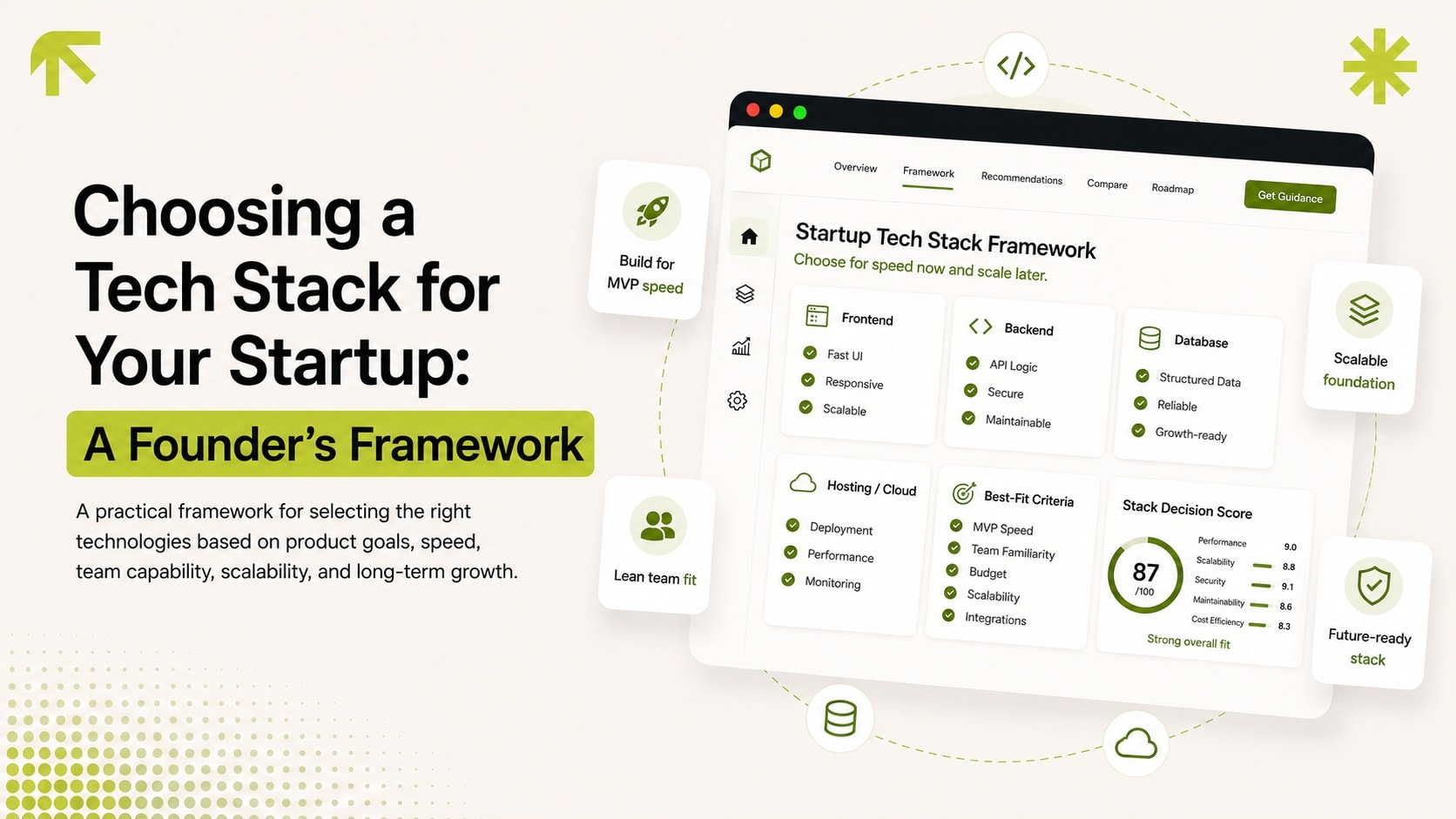
Most founders can't evaluate a tech stack on its technical merits, and they shouldn't have to. What actually matters is whether the stack fits the product, the team, and the timeline, not whether it's the newest or most talked-about option. Here's a framework for that decision without needing a computer science degree.
Start with what the product actually needs to do
A marketing site with a contact form has completely different requirements than a real-time dashboard with user accounts and payments. Before any stack conversation, get clear on: does this need to handle logins, does it need to process payments, does it need real-time updates, and how much content will non-technical staff need to manage themselves.
Questions to ask any developer recommending a stack
"Why this, and not the alternative?" A developer who's actually built things will have a specific answer tied to your product. A vague answer ("it's modern," "it's popular") is a signal they're recommending what they know, not what fits.
"What happens when we need to scale this?" Some stacks handle growth gracefully; others need a rebuild at a certain point. Ask what that ceiling looks like for your specific plan.
"Who else can maintain this if you're not available?" A stack built on a widely-used, well-documented framework is much easier to hand off than something obscure or overly custom.
Red flags in a stack recommendation
Watch for a developer recommending the newest, least-proven option for a business-critical product, or recommending something unusual without a specific reason tied to your requirements. The right stack for a startup's marketing site or first product is almost always a well-established, production-proven one, not an experiment.
What we actually default to, and why
For most startup builds, we default to Next.js on the frontend, Node.js on the backend, and MongoDB or PostgreSQL depending on the data shape, the same combination behind builds like our web app and dashboard work. Not because it's trendy, but because it's fast to build with, well-documented, and easy to hand off to another developer later if needed. If you're weighing this against a simpler option first, see our breakdown of when custom software actually beats an off-the-shelf tool, and if you're deciding between a web app and a native mobile app, see which to build first as a startup.
If you're at the point of actually scoping a build, this pairs directly with the MVP scoping questions we ask before any project starts, tech stack is usually one of the first five things worth nailing down.
A real example of this decision in practice
When we scoped Grill Bucket's ordering platform, the alternative on the table was a page-builder plugin bolted onto an existing WordPress site, the faster-to-start option on paper. We recommended against it because the actual requirement, real-time order management plus a frequently-changing menu and deals structure, needed an application, not a content page with a form attached. A page builder would have hit its ceiling within months as the menu and promotions grew more complex. That's the real test: not which stack is fastest to start with, but which one still works once the product has grown past its first version.
Frequently Asked Questions
How do I evaluate a tech stack if I'm not technical myself?
Should I always go with the newest, most popular framework?
What if my developer recommends something I've never heard of?
Does the stack choice affect how easy it is to hire help later?
Can I change the stack later if it turns out to be wrong?
Ready to Build Something
That Gets You Clients?
Free 30-minute consultation. We'll map out your project and agree on a price together. No commitment, no pressure.
Book My Free Call